 blog
What Should You Look for When Buying Ranch Land?
Last Updated: October 25, 2026
Quick Summary
Buying ranch land requires clarity about your goals and a realistic assessment of operating costs over five to ten years. Before committing, understand water rights, mineral rights, regional pricing, and whether you want a recreational or working ranch, each demands different infrastructure, expertise, and financial planning.
- Water rights in Texas are complex and non-negotiable; verify wells, permits, and historical drought-period availability before making an offer.
- Mineral rights may be separated from surface rights, allowing oil or gas companies to drill on your property regardless of your ownership.
- Down payments typically range from 20% to 35% for raw or recreational land, with Farm Credit System and USDA FSA loans common financing options.
- Ranch appraisals weigh comparable sales, water resources, soil productivity, and improvements; comparable sales can be scarce in thin rural markets.
- Annual operating costs include property taxes, fence and road maintenance, water system repairs, insurance, and land management, often exceeding initial purchase expectations.
Table of Contents
- Is Ranch Land a Sound Investment for Your Goals?
- Defining Your Intended Use: Recreational Ranch vs. Working Ranch
- Understanding Water Rights and Groundwater Availability
- Mineral Rights, Oil and Gas, and Surface-Use Conflicts
- Texas Ranch Land Prices Per Acre and Regional Variations
- How to Finance Land in Texas: Loans, Down Payments, and Pre-Approval
- Your Ranch Land Buying Checklist: Essential Due Diligence Steps
- Connect With an Expert to Start Your Ranch Purchase
- Frequently Asked Questions
Is Ranch Land a Sound Investment for Your Goals?
Buying ranch land in Texas requires clarity about your goals.
Ranch land serves different purposes: a financial investment, a working operation generating income through livestock or crops, or a recreational retreat or home site.
Consider operating costs before you commit. An affordable-looking property can become a burden once you factor in property taxes, maintenance, utilities, and improvements.
The investment case varies by region and property type. Some areas appreciate steadily; others stay flat for years.
Defining Your Intended Use: Recreational Ranch vs. Working Ranch
The choice between a recreational and a working ranch shapes every decision that follows, requiring different infrastructure, expertise, and financial commitments.
A recreational ranch prioritizes lifestyle: hunting, horseback riding, weekend retreats, or simply owning land in a beautiful setting.
A working ranch generates income through cattle, sheep, goats, or crops.
Infrastructure differs dramatically. A recreational property might need a house, road access, and basic utilities.
For first-time buyers without ranching experience, working vs recreational ranches: choose right provides a detailed comparison to help you decide which path fits your situation and skill level.
Intended use also affects financing and valuation.
Understanding Water Rights and Groundwater Availability
Water is the foundation of ranch viability in Texas.
Texas water law is complex: surface water from rivers, creeks, and lakes is state-regulated, while groundwater falls under different legal frameworks depending on location (Water for People and the Environment Chapter 14).
Ask the seller directly: What water rights are included? Are there existing wells, how much do they produce, and have rates changed over time?
Groundwater availability varies across Texas. We recommend how to verify water rights on Texas ranch land to learn the verification steps before you make an offer.
Drought affects water reliability. Texas has seen severe droughts in recent decades, and properties that seemed water-rich in wet years can face shortages in dry ones (| U.S. Drought Monitor).
Mineral Rights, Oil and Gas, and Surface-Use Conflicts
Many Texas ranch buyers overlook mineral rights until problems emerge. Mineral rights, the legal claim to oil, gas, minerals, and other subsurface resources, may or may not come with your purchase, and in Texas they can be separated from surface rights and owned by different parties (Oil & Gas Exploration and Surface Ownership).
This separation creates risk.
Before you buy, confirm: Do the mineral rights convey with this sale? If not, who owns them?
Surface-use conflicts arise when mineral rights holders exercise their claims. Drilling can damage pasture, create noise and traffic, and limit your use of portions of the property.
We recommend how to research mineral rights before buying land to understand the verification process and what to look for in mineral right documentation before making an offer.
Connect with Monica Allison now. →
Texas Ranch Land Prices Per Acre and Regional Variations
Ranch land prices in Texas vary by region, water availability, soil quality, and proximity to population centers.
Prices per acre reflect local conditions.
Research comparable sales in your target region from the past 12 to 24 months.
Regional variations reflect different agricultural and recreational markets. South Texas ranch country differs from the Hill Country, and Coastal Bend properties differ from Panhandle ranches.
We recommend how to assess ranch land investment potential to learn how to evaluate whether a property's price aligns with its actual investment potential in your target region.
How to Finance Land in Texas: Loans, Down Payments, and Pre-Approval
Financing ranch land is not a scaled-up home mortgage.
Know the lender categories. Ranch buyers typically work with one of four lender types:
- Farm Credit System institutions. These are borrower-owned cooperatives chartered to serve agricultural producers. They are often the most ranch-fluent lenders, offering land loans, operating lines, and equipment financing. Membership and stock purchase requirements vary by association.
- Community and regional banks with agricultural departments. Many rural banks hold ranch loans in portfolio rather than selling them, which gives them flexibility on property characteristics that government-sponsored residential loans won't touch.
- U.S. Department of Agriculture (USDA) Farm Service Agency (FSA) guaranteed loans. FSA does not lend directly for most farm real estate; instead it guarantees a portion of a loan made by a commercial lender, which can reduce the lender's risk and improve terms for qualifying borrowers. Eligibility, acreage limits, and borrower-status rules apply, confirm current program details with your local FSA office.
Expect underwriting questions specific to land. Lenders commonly ask about:
- Water rights and well documentation
- Mineral rights status and any active leases
- Access easements and legal road frontage
Get pre-approved before you shop. Pre-approval clarifies your buying power and signals seriousness in a market where rural listings move quickly.
Compare total cost, not just rate. Ranch loans often carry shorter amortization (commonly 15 to 25 years), variable-rate structures, and different prepayment terms. A slightly higher rate with a longer fixed period and no prepayment penalty can be the better deal for a long-hold buyer. Model the full term, not just year one.
For a deeper walkthrough of loan structures and lender selection, see how to finance ranch land in Texas.
Ranch buyers typically work with four main types of lenders, each with different strengths and requirements.
| Lender Type | Primary Focus | Key Characteristic |
|---|---|---|
| Farm Credit System | Agricultural producers | Borrower-owned cooperatives, often most ranch-fluent |
| Community and regional banks | Rural agricultural lending | Hold loans in portfolio, flexible on property characteristics |
| USDA Farm Service Agency | Farm real estate | Guarantees portion of commercial lender loans, reduces risk |
| Specialty land lenders | Unimproved and recreational land | Accept properties conventional lenders decline, higher rates |
Your Ranch Land Buying Checklist: Essential Due Diligence Steps
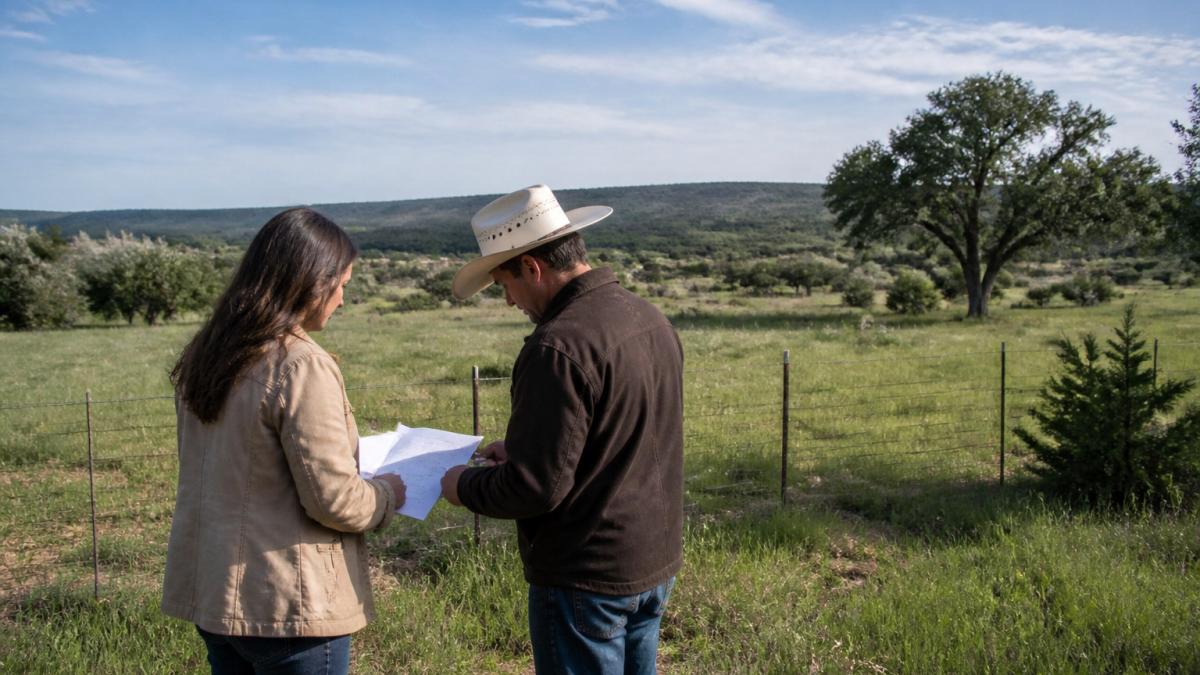
Most buyers know to order a title search and survey. Fewer know how to inspect a ranch's working infrastructure or budget for keeping it running. This checklist covers the items that actually decide whether a ranch purchase works.
Title, Boundary, and Access Due Diligence
- Obtain a full title commitment and review every exception and requirement, not just the schedule of ownership.
- Verify acreage against the deed and a current survey; acreage discrepancies are common on rural tracts and affect price per acre.
- Confirm legal access. A property that touches a public road is different from one reached only by an easement across a neighbor's land. Review the easement's recorded terms, width, maintenance obligations, and whether it is exclusive or shared.
Water: Wells, Surface Water, and Drought History
- Confirm which water rights convey and obtain documentation: well registrations, permits, and any surface-water rights.
- Request well logs and production history. Ask how yield has changed over time and whether the well has ever gone dry.
- Have a qualified well inspector test yield and water quality before closing.
Mineral Rights and Surface-Use Risk
- Confirm whether mineral rights convey with the surface estate.
- Identify who owns severed minerals and whether any oil, gas, or other leases are recorded.
- Review lease terms for surface-use rights: location of roads, pads, pipelines, and equipment.
Ranch Infrastructure Inspection Checklist
This is where ranch purchases diverge from residential ones. Walk the property with the seller or a ranch-savvy inspector and document condition:
- Fences and gates: perimeter and cross-fencing condition, type (barbed wire, woven wire, electric), gate count and condition, and estimated replacement cost per linear foot.
- Roads and culverts: all-weather access, drainage, erosion, and who maintains shared roads.
- Barns and outbuildings: structural condition, roof, electrical, and whether they meet intended use.
Environmental and Climate Exposure
- Review floodplain maps and drainage patterns; low-water crossings and creek bottoms can become impassable.
- Assess wildfire risk: vegetation, defensible space around structures, and access for fire equipment.
- Understand drought exposure for your region and how it affects water and forage.
Taxes, Insurance, and Operating Budget
- Research property tax history and current assessed value; confirm any agricultural valuation or exemption and what it requires to maintain.
- Get insurance quotes for the property, including structures and any liability coverage.
- Build a realistic annual operating budget, not just a purchase budget. Common recurring costs include:
- Property taxes
- Fence and road maintenance
- Water system repairs and electricity for pumps
- Insurance
- Land management, brush control, and wildlife or livestock expenses
- Equipment maintenance and replacement reserves
Local Regulations and Professional Review
- Confirm zoning or county regulations allow your intended use.
- Review building codes, setback requirements, and any conservation or environmental restrictions.
- Hire a qualified inspector for structures and systems, a surveyor to verify boundaries and easements, and an attorney to review all documents.
- Talk with local ranchers and a land professional who knows the county, property-specific issues rarely show up in public records.
For a step-by-step verification process on water and mineral rights, see how to verify water rights on Texas ranch land and how to research mineral rights before buying land.
Connect With an Expert to Start Your Ranch Purchase
Buying ranch land in Texas is complex. Water rights, mineral rights, regional market dynamics, and long-term financial planning all demand expertise. Working with someone who understands both the ranch and real estate sides protects your interests and clarifies your path forward.
At Monica Allison, realtor, we help buyers navigate these decisions with experience across residential and ranch properties in the Texas Hill Country.
Frequently Asked Questions
What is the difference between a recreational ranch and a working ranch?
A recreational ranch is typically smaller, used for hunting, fishing, or weekend getaways, and requires minimal active management. A working ranch operates as a livestock or agricultural business, demands year-round management, generates ongoing income or expenses, and often has higher operating costs. Your choice affects financing options, required infrastructure, zoning compliance, and long-term financial returns.
How much does an acre of ranch land cost in Texas?
Ranch land prices vary significantly by region, water availability, soil quality, and proximity to urban areas. Factors like mineral rights, existing infrastructure, and intended use also influence pricing. Contact a local realtor familiar with your target region for current market data and comparable sales.
What should you check about water access before buying ranch land?
Verify surface water availability (creeks, ponds, stock tanks) and groundwater access through well records and geological surveys. Confirm water rights ownership, some properties have limited or no water rights despite having water on the land. Check for competing water claims, drought history, and any restrictions on water use. Have a well inspector test groundwater quality and flow rate if you plan to rely on well water for livestock or household use.
How do you finance a land purchase in Texas?
Land loans typically require 20-30% down payment and have higher interest rates than home mortgages. Options include agricultural loans from USDA or farm credit lenders, conventional bank loans, seller financing, or portfolio loans. Get pre-approved before making offers. Your intended use (investment, livestock, recreation) affects which lenders will work with you and what terms they offer.
The ranch land buying process rewards preparation and expert guidance. Start by clarifying your investment goals, understanding your financing options, and conducting thorough due diligence on any property you're considering. Connect with Monica Allison, realtor to discuss your ranch purchase plans and explore properties that align with your vision.