 How-to
How to Price Ranch Property for Sale: A Step-by-Step Guide
Table of Contents
- How to Price Ranch Property: The Core Valuation Process
- How to Value a Ranch: Understanding Land vs. Improvements
- Ranch Price Per Acre: What It Reveals and What It Misses
- Factors Affecting Ranch Value: Location, Water, and Access
- Adjusting Comparable Sales to Arrive at Your Price
- When to Seek a Professional Appraisal or Market Analysis
- Pricing Strategy: Setting Your Asking Price and Negotiation Range
- Conclusion
- Frequently Asked Questions
Last Updated: October 17, 2026
How to Price Ranch Property: The Core Valuation Process
Pricing a ranch property correctly is the foundation of a successful sale. Too high, and you'll sit on the market indefinitely. Too low, and you'll leave money on the table.
At Monica Allison, realtor, we've helped ranchers and landowners in the Texas Hill Country navigate this process for years.
Step 1: Gather Your Property Data
Start by documenting everything about your ranch. This isn't just about acreage, it's about creating a complete picture of what makes your property unique.
Create a detailed inventory:
- Total acreage and parcel configuration
- Building improvements (main house, barns, structures, condition)
- Water features and water rights status
- Fencing type and condition
- Road access and utility connections
- Soil quality and terrain type
- Wildlife habitat and recreational potential
- Any easements or mineral rights issues
Take photographs and measurements. Walk the property with a GPS device to verify acreage. Pull your property deed to confirm water rights and any restrictions. This data becomes your baseline for every comparison you'll make.
Step 2: Research Ranch Land Comparable Sales
Comparable sales are the most reliable way to price ranch property for sale.
What makes a property comparable:
- Similar acreage (within 20-30% of your size)
- Same general region or ecoregion
- Comparable water access and rights
- Similar terrain and soil quality
- Same intended use (hunting, grazing, residential)
Find closed sales through county records, MLS databases, and local real estate agents. Don't rely on asking prices, only closed sales matter.
Document at least 3-5 comparable sales with their sale price, acreage, key features, and days on market. This gives you a data range to work from.
Step 3: Analyze Market Conditions in Your Region
Market conditions shift. A property worth $2,500 per acre in a hot buyer's market might be worth $2,100 per acre six months later if demand cools.
Consider these factors:
- Are buyers actively competing for properties, or is inventory high?
- How long are comparable properties taking to sell?
- Is buyer demand increasing or decreasing?
- Are there seasonal patterns in your market?
- What's the broader economic outlook for your region?
If comparable properties are selling in 30-45 days with multiple offers, you're in a seller's market. Price more aggressively. If properties are sitting 120+ days, you're in a buyer's market. Price conservatively to attract offers quickly.
How to Value a Ranch: Understanding Land vs. Improvements
Many sellers make a critical mistake: they bundle everything together and assume the price per acre tells the whole story. It doesn't. A ranch's value is actually three separate components working together.
Separating Land Value from Buildings and Infrastructure
The land itself has one value. The buildings, fencing, utilities, and improvements have another.
Improvement value includes structures, fencing, water systems, roads, and any infrastructure. A well-maintained barn might add $50,000 to value.
Functional value comes from what the property can do.
When pricing ranch property for sale, separate these mentally.
Income-Producing Capacity and Carrying Capacity
If your ranch generates income, through grazing leases, hunting licenses, or agricultural production, that income affects value.
Carrying capacity is the number of animals the land can sustainably support.
Income-producing history matters.
When you price ranch property for sale, document any income the property currently generates. This becomes part of the valuation conversation.
Ranch Price Per Acre: What It Reveals and What It Misses
Price per acre is a useful starting point. It's not the full answer.
Calculating Price Per Acre for Your Property
The math is simple: divide the total sale price by total acreage. A ranch that sold for $500,000 with 200 acres = $2,500 per acre.
Use this calculation for your comparable sales too. It gives you a quick benchmark to compare properties of different sizes.
But here's where it gets tricky: a 50-acre property with excellent water and road access might sell for $3,500 per acre.
Why Price Per Acre Can Be Misleading
Price per acre flattens complexity. It assumes all acres are equal. They're not.
Price per acre works best when comparing properties of similar size, use, and characteristics in the same region.
When you price ranch property for sale, calculate your per-acre range based on comparables, but then adjust for your property's specific features.
Factors Affecting Ranch Value: Location, Water, and Access
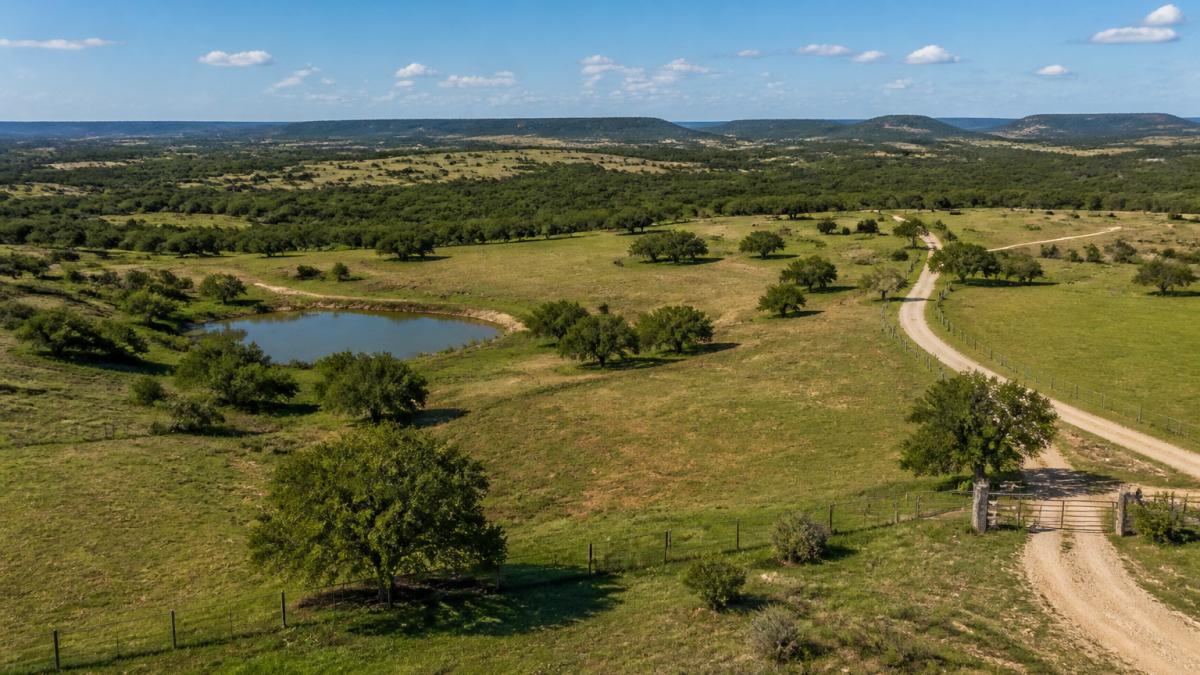
Three factors dominate ranch property value: where it is, whether it has water, and how you get to it.
Water Rights and Water Features
Water is non-negotiable. A ranch without reliable water is nearly unsellable.
Document your water situation clearly:
- Permanent water source (well, creek, tank, spring)
- Water rights status (riparian rights, water district membership, senior/junior rights)
- Water quantity (gallons per day, seasonal variation)
- Water quality (tested, suitable for livestock or human use)
- Improvements (pumps, pipelines, storage tanks, troughs)
Properties with senior water rights command premium prices. Properties dependent on seasonal water are worth less.
If your property has water issues, contamination, limited quantity, or unclear rights, disclose them upfront. Buyers will discover them anyway, and transparency builds trust.
Soil Quality, Terrain, and Wildlife Potential
Soil quality determines what the land can produce. Sandy, rocky, or clay-heavy soils have different carrying capacities and productivity levels.
Terrain affects usability. Flat, accessible land is more valuable than steep, rugged terrain.
Wildlife potential is significant in the Texas Hill Country.
When pricing ranch property for sale, highlight soil quality, terrain advantages, and wildlife potential. Get a soil survey if you don't have one.
Road Access, Utilities, and Fencing
Poor access kills deals. A property with a long, rough ranch road is worth less than one with paved road frontage.
Utilities matter too:
- Electricity to the main structures
- Water line connections
- Cell service availability
- Internet availability
Fencing condition affects value. New fencing adds value. Deteriorated fencing requires buyer investment and reduces price.
Connect with Monica Allison now. →
When you price ranch property for sale, assess these practical factors honestly. They're what buyers think about first.
Adjusting Comparable Sales to Arrive at Your Price
Raw comparable sales give you a starting range. Now adjust for differences between those properties and yours.
The Adjustment Process: A Worked Example
Let's say you found three comparable sales in your region:
Property A: 150 acres, $375,000 ($2,500/acre), sold 8 weeks ago Property B: 180 acres, $432,000 ($2,400/acre), sold 12 weeks ago Property C: 120 acres, $288,000 ($2,400/acre), sold 6 weeks ago
Your property: 160 acres, similar region, similar terrain.
Start with Property B as your baseline ($2,400/acre). Now adjust for differences.
If your property has better water access than Property B, add 5-10% ($120-240 per acre).
If your property has road frontage while Property B didn't, add 3-5% ($72-120 per acre).
After adjustments, you're looking at roughly $2,300-2,500 per acre for your 160-acre property. That's $368,000-$400,000.
Common Adjustments: Acreage, Water, and Improvements
Standard adjustments experienced ranchers and real estate professionals use:
Acreage size: Larger properties often sell for less per acre. A 500-acre ranch might be $2,000/acre while a 50-acre ranch is $3,000/acre in the same area.
Water availability: Add 10-20% for reliable, senior water rights. Subtract 15-30% for properties with water uncertainty.
Improvements: A functional barn adds 5-8%. A well-maintained house adds 15-25%. Deteriorated structures subtract value.
Road access: Paved road frontage adds 5-10%. Long ranch roads subtract 5-15%.
Wildlife value:
Make adjustments methodically. Document your reasoning. This becomes your justification when buyers question your asking price.
When to Seek a Professional Appraisal or Market Analysis
Sometimes you need expert help to price ranch property for sale accurately.
Signs Your Ranch Needs a Formal Valuation
Consider hiring a professional appraiser if:
- Your property has unique characteristics that complicate valuation
- Water rights or mineral rights issues create uncertainty
- The property generates agricultural or hunting income
- You're selling to an investor or institutional buyer
- You're facing a contested valuation with family members
- The property is unusual in size, use, or configuration
- You want documentation for tax or estate purposes
- You need to defend your price to lenders or buyers
A formal appraisal provides defensible documentation of value.
What to Expect from a Ranch Appraisal
A qualified appraiser will:
- Research comparable sales in detail
- Inspect your property thoroughly
- Analyze land characteristics (soil, water, terrain, wildlife)
- Evaluate improvements and infrastructure
- Consider market conditions and buyer demand
- Provide a written report with detailed justification
The appraisal becomes your anchor point. It's harder to argue with a professional valuation than with your own estimate.
For properties in the Texas Hill Country, work with appraisers who specialize in ranch and agricultural land. They understand regional nuances and local market dynamics that generalist appraisers miss.
Pricing Strategy: Setting Your Asking Price and Negotiation Range
Your asking price isn't your final price. It's your opening position in a negotiation.
Pricing for Market Conditions
In a seller's market (high demand, low inventory), price at or slightly above your valuation. Buyers are competing. You can hold firm.
In a buyer's market (low demand, high inventory), price slightly below your valuation. You need to attract offers quickly. Aggressive pricing generates interest.
The sweet spot: price where you'd be comfortable accepting an offer.
Building in Buffer Room for Negotiation
Most buyers expect to negotiate. They'll offer 5-10% below asking price as an opening move.
If you price at $400,000 expecting $380,000 offers, you're prepared.
Build in realistic buffer room.
Example: Your true valuation is $400,000. Price at $420,000. When a buyer offers $378,000, you counter at $405,000.
When you price ranch property for sale, think like a buyer. What would make you submit an offer?
Conclusion
Pricing ranch property for sale requires balancing data, market conditions, and negotiation strategy. Start with comparable sales.
If you're uncertain about your valuation, get a professional appraisal.
The process isn't guesswork. It's systematic analysis that reflects what informed buyers will actually pay.
Working with Monica Allison, realtor means getting pricing guidance from someone who understands the Texas Hill Country market.
Frequently Asked Questions
How do you determine the value of a ranch property?
Start by gathering your property data: acreage, improvements (buildings, fencing, roads), water features, and location. Then research comparable sales of similar ranches in your region sold in the last 6-12 months. Adjust those comparable prices for differences in acreage, water rights, soil quality, and access. For complex or high-value properties, a professional appraisal by a ranch specialist provides the most defensible valuation. The goal is to arrive at a price per acre and total asking price that reflects current market conditions for your specific property type.
What factors affect the price of ranch land most significantly?
Water access and water rights are typically the most valuable factors, a ranch with reliable water commands premium pricing. Location and regional market demand come second; a ranch near growing areas or with recreational value will price higher than remote agricultural land. Hunting and recreational potential can also increase value in certain markets. Soil quality and carrying capacity affect agricultural productivity and value. Access to utilities and paved roads increases value. Finally, improvements like quality fencing, barns, and livestock facilities add to the asking price. Hunting and recreational potential can also substantially increase value in certain markets.
How should you adjust comparable sales when pricing a ranch?
For each comparable property, identify differences between it and your ranch: acreage, water availability, road access, fencing condition, building quality, and soil type. Assign a dollar adjustment for each difference. If a comparable sold for $800,000 but has better water access than your property, subtract an adjustment for that advantage. If your ranch has more acreage, add a per-acre adjustment. Document your reasoning for each adjustment. This method produces a range rather than a single price, which helps you set a defensible asking price and understand your negotiation range.
Should ranch land always be priced per acre?
Price per acre is a useful comparison tool but can be misleading on its own. Two ranches at $5,000 per acre may have very different values if one has excellent water and the other does not. Per-acre pricing works best for large, uniform agricultural operations. For smaller ranches with significant improvements, wildlife value, or unique features, price the total property and use per-acre figures as context, not the primary valuation method. Always consider the full bundle of land, water, access, and improvements rather than relying on per-acre pricing alone.