 How-to
Building on Limestone Soil: Foundation Challenges
Last Updated: November 21, 2026
Quick Summary
Building on limestone soil brings foundation challenges from hidden voids, cavities and uneven rock layers that cause differential settlement and structural movement. Solid limestone is an excellent bearing surface, but karstic limestone with cavities and clay-filled seams is not, so a geotechnical investigation is essential before you design or build.
- A geotechnical investigation performed by a licensed engineer is the only reliable way to find out what is under your land.
- The most expensive mistake is assuming a visible rock outcrop means solid rock everywhere.
- Excavating limestone is slower and costlier than digging ordinary soil because rock often must be ripped, chipped or blasted.
- If excavation exposes a cavity or soft seam, stop and get the engineer back on site before placing concrete.
- Direct downspouts and surface water away from the foundation, keep swales and ditches clear, and fix plumbing leaks fast.
Table of Contents
- Why Limestone Soil Changes the Building Equation
- Common Limestone Soil Foundation Problems
- Geotechnical Investigation for Building Sites: What to Test and Why
- Excavating Limestone for Construction: Equipment, Effort and Cost
- Foundation Design on Limestone: Matching the System to the Site
- Water, Drainage and Long-Term Site Management
- Preconstruction Checklist and Quality Control for Limestone Sites
- Buying Limestone Land? Talk to Monica Allison Before You Build
- Frequently Asked Questions
Why Limestone Soil Changes the Building Equation
Building on limestone soil is not automatically a problem, but it does change how you plan, test, and pay for a foundation. Limestone is a soluble rock, so water slowly dissolves it over time.
Buyers should understand these risks before they commit to a tract in the Texas Hill Country. The land can be beautiful and still hide expensive surprises under the grass.
Here is the core idea. Solid limestone makes an excellent bearing surface. Karstic limestone, riddled with cavities and clay-filled seams, does not. The difference between the two decides your foundation design, your excavation budget, and your construction timeline.
Below, we break down what to test, what to expect, and how to avoid the costly mistakes we see most often.
Common Limestone Soil Foundation Problems
Limestone soil foundation problems usually trace back to one of two causes: hidden voids below the surface, or uneven support across the footprint. Both show up later as cracks, sticking doors, and sloping floors.
The U.S. Geological Survey's karst terrain resources notes that soluble bedrock underlies large parts of the country, and that dissolution features can be difficult to see from the surface. That is the central challenge. What looks like a flat, solid building pad may sit over a cavity or a pocket of soft clay.
Karst Features, Cavities and Hidden Voids
Karst is the term for terrain shaped by dissolved bedrock. It includes sinkholes, caves, underground drainage channels, and the cavities that connect them.
A cavity under a footing removes support. If the roof of that cavity collapses, the ground above drops with it. Small voids may stay stable for decades. Larger ones, or ones near the surface, can fail during construction or after the first heavy rain.
Watch out: the most expensive mistake is assuming a visible rock outcrop means solid rock everywhere. Outcrops tell you almost nothing about conditions twenty feet away.
Differential Settlement and Structural Movement
Differential settlement is when one part of a foundation sinks more than another. Limestone sites produce it when part of the footing rests on competent rock and part rests on soil or a weak seam.
The result is structural movement. You see stair-step cracks in brick, gaps around windows, doors that no longer latch, and floors that slope. Long-term settlement can continue for years if water keeps washing soil into voids.
Geotechnical Investigation for Building Sites: What to Test and Why
A geotechnical investigation for building sites is the only reliable way to find out what is under your land. A geotechnical investigation is typically performed by a licensed engineer, who drills, samples, and tests the subsurface.
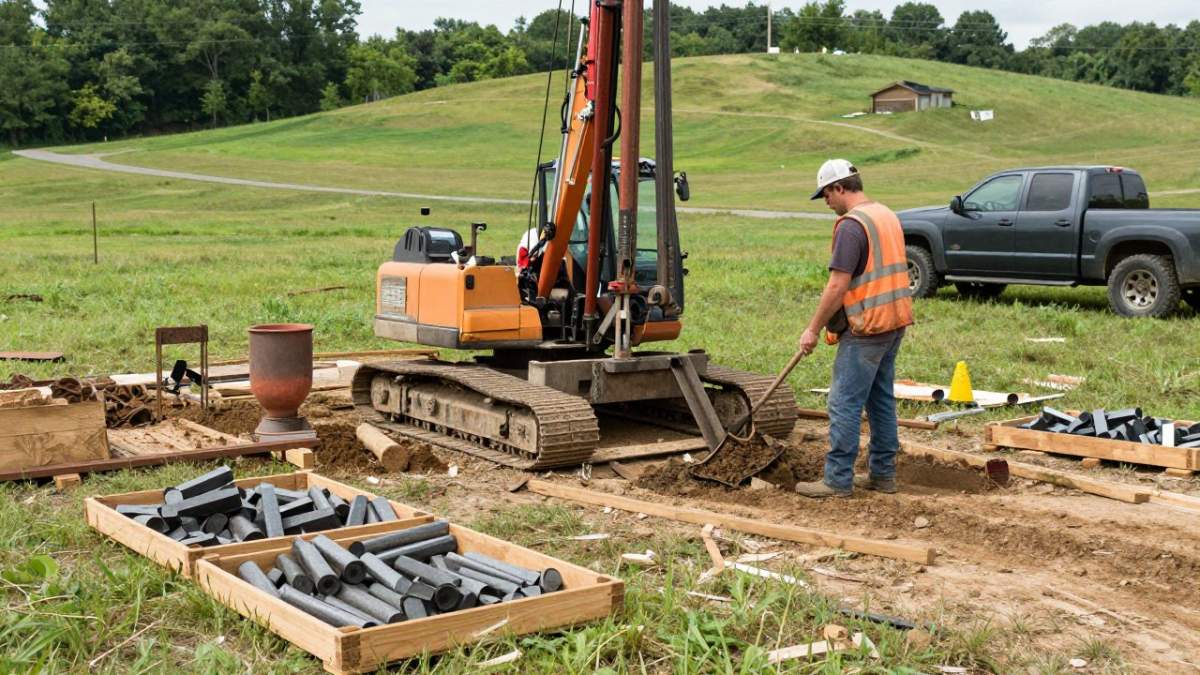
Do not skip this step to save money. A geotechnical report is far less costly than repairing a failed foundation.
Investigation Methods and What Each One Detects
Each method answers a different question, and a good investigation uses more than one.
Records review first. Before any rig arrives, pull the county soil survey, existing geologic maps, and any prior site reports.
Test pits are shallow excavations, typically dug with a backhoe, that expose soil layers and the top of rock.
Boreholes are drilled holes that log soil strength and rock depth.
Seismic refraction sends sound waves through the ground and measures how they refract at layer boundaries.
Ground-penetrating radar and other geophysical surveys can spot shallow voids and cavities.
Probe drilling uses a small-diameter probe to test for voids or soft zones between boreholes.
Ask the engineer to log rock quality carefully.
Turning Findings into a Design Basis
The investigation is only useful if it answers three questions: Where is competent rock? How variable is the site across the footprint? Are there cavities or weak seams that could cause settlement?
The report should state a recommended foundation type and a bearing capacity the designer can use. If the borings show competent rock at shallow depth across the whole footprint, the engineer may recommend conventional footings.
Watch out: a report that lists soil layers but never states a design bearing value or a foundation recommendation is incomplete. Ask for the design basis in writing before you rely on it.
Excavating Limestone for Construction: Equipment, Effort and Cost
Excavating limestone for construction is slower and costlier than digging ordinary soil. Limestone often must be ripped, chipped, or blasted rather than scooped.
Standard excavators struggle with hard rock. Contractors bring in hydraulic breakers, rock rippers, or drilling and blasting crews. Each adds equipment cost, labor, and time. Unexpected rock can also push a project schedule back by weeks.
Costs vary widely by site, rock hardness, and access. A tract with shallow, fractured limestone is far cheaper to prepare than one with deep, solid ledges. Because pricing depends heavily on site-specific conditions, obtaining contractor bids before closing is advisable.
Hidden costs can wreck a raw-land budget. For a closer look at what else can surprise you, read Are Hidden Costs Eating Into Your Texas Raw Land Budget?.
Foundation Design on Limestone: Matching the System to the Site
Foundation design on limestone starts with the geotechnical report, not a standard plan. The engineer matches the system to what the borings actually found.
Bearing capacity is the load the ground can carry without failing. Competent limestone offers high bearing capacity. Weathered or cavity-riddled rock offers much less.
A Decision Framework Tied to Site Findings
The table below shows how typical site conditions point toward different foundation systems. It is a starting point for a conversation with a licensed engineer, not a substitute for one.
| Site Finding | Likely Foundation Direction | Why |
|---|---|---|
| Competent rock at shallow depth across the footprint | Shallow footings or spread footings | Rock can carry the load directly; minimal excavation |
| Competent rock at depth below weak soil or seams | Piers or drilled shafts socketed into rock | Transfers load past weak zones to solid bearing |
| Variable rock depth or quality across the footprint | Mat foundation or a mix of footings and piers | Spreads load and tolerates differential support |
| Cavities or voids confirmed below the footprint | Grouting or void filling before construction, plus a deep foundation | Stabilizes the ground so the foundation has continuous support |
| Highly fractured or clay-filled rock | Ground improvement or a deep foundation system | Fractured rock behaves more like soil than solid rock |
Shallow foundations and footings work when the report shows competent rock at shallow depth. They are the cheapest option because they require the least excavation and the least specialized equipment.
Piers and rock sockets are drilled into competent rock below weak zones.
Mat foundations spread load across a large area, which helps when rock depth or quality varies. A mat tolerates differential settlement better than isolated footings because the whole footprint moves together.
Underpinning or grouting fills voids before building.
When the Engineer Should Reassess
Design is not finished when the report is issued. Conditions found during excavation can differ from what the borings suggested, and the engineer should be called back when that happens.
Watch out: if excavation exposes a cavity, a soft seam, or rock that crumbles rather than holds, stop and get the engineer back on site before placing concrete. A footing poured over an unaddressed void is a settlement claim waiting to happen.
The decision framework is simple. If the report shows competent rock at shallow depth, conventional footings work. If it shows cavities or deep weak zones, expect piers socketed into solid rock. If conditions vary across the footprint, expect a mix.
Water, Drainage and Long-Term Site Management
Water is what drives limestone dissolution and most settlement on these sites. Managing it is a permanent job, not a one-time fix.
Groundwater moving through limestone widens cracks and carries soil into voids. Roof runoff, poor grading, and failed drainage all speed that up. Direct downspouts and surface water away from the foundation. Keep swales and ditches clear. Fix plumbing leaks fast.
Drainage concerns also raise questions about easements and how water crosses a property. If you are weighing long-term site management, see Identifying Hidden Easements on Rural Property.
Preconstruction Checklist and Quality Control for Limestone Sites
A preconstruction checklist keeps small oversights from becoming structural problems. Quality control during the build matters just as much as the design.
Use this checklist before you break ground:
- Geotechnical report in hand, reviewed by the foundation engineer
- Voids and soft spots identified and addressed in the design
- Drainage plan graded away from the footprint
- Contractor experienced with rock excavation and karst sites
- Inspection schedule set for footing, pier, and concrete stages
- Proof of rock bearing surface confirmed before pouring
During construction, verify that footings actually bear on the rock the report described. A common mistake is pouring concrete into a cavity without cleaning it out first. For the broader list of costly rural acreage buying mistakes to avoid, read How to Avoid Costly Rural Acreage Buying Mistakes.
Buying Limestone Land? Talk to Monica Allison Before You Build
The cheapest time to solve a limestone problem is before you buy the land. A geotechnical review and a careful look at the property can save you from a foundation nightmare later.
If you are evaluating a tract, start with the general due-diligence checklist in What Should You Look for When Buying Ranch Land?. It covers the questions worth asking before you commit.
Limestone land rewards buyers who do their homework and punishes those who skip it. Monica Allison helps clients read the land before they sign, and she knows which questions to raise with engineers, contractors, and title companies. As a licensed realtor working farm, ranch, and residential property across the Texas Hill Country, she can guide you through site review, easements, and water rights.
Frequently Asked Questions
Can you build a house on limestone bedrock?
Yes, and many homes sit on solid limestone. The deciding factor is whether the rock is sound and continuous or broken up by cavities, clay-filled seams and voids. A geotechnical investigation with borings and rock coring tells you which condition you have. Solid, competent limestone can carry footings or piers with modest settlement; karstic limestone needs a different foundation system and a larger budget for excavation and concrete.
What are the most common limestone soil foundation problems?
The big four are differential settlement where rock depth changes abruptly, sinkholes and cavities that open under a footing, water moving through dissolution channels and softening the supporting soil, and excavation that runs into rock earlier than planned. Each one shows up in testing before construction. Skipping that testing is how a budget-friendly lot turns into a foundation repair project.
How does limestone affect excavation and foundation costs?
Rock excavation is the main cost driver. Digging through limestone typically requires specialized equipment and can take several times longer than digging in soil, and the deeper and harder the rock, the more the earthwork line grows. Foundation design also changes the number: piers socketed into rock, reinforced slabs and void-forming systems cost more than a standard spread footing. Get a geotechnical report and a site-specific bid before you commit.
Does limestone soil cause drainage problems?
It can, in both directions. Limestone dissolves over time, so water can move quickly through cracks and solution channels, which is good for drainage but bad if that water reaches the foundation zone. Clay-rich soil pockets over limestone can also hold water against a foundation. Grading the site away from the house, keeping gutters and downspouts clear, and managing runoff are the practical defenses.