 How-to
7 Signs Your Rural Property Has a Landlocked Access Problem
Quick Summary
A landlocked property is land with no legal right of access to a public road, meaning no recorded, enforceable route across another parcel. You can spot the problem by checking the deed, title commitment, and county records for recorded easements, confirming public road frontage, and comparing the physical route you can drive with the legal right to use it.
- Check the title commitment's Schedule B exceptions for access-related items before you commit.
- Confirm with county records whether the road is county-maintained, state-maintained, or private.
- A route you can drive is not automatically a route you have a legal right to use.
- Only a recorded express easement gives the strongest legal access position.
- Do not rely on a seller's verbal assurance or long informal use as proof of access.
Table of Contents
- What Landlocked Property Means and Why It Matters
- Step 1: Check the Deed, Legal Description, and Title Commitment
- Step 2: Confirm Public Road Frontage with County Records
- Step 3: Walk the Route and Compare Physical and Legal Access
- Step 4: Understand Types of Access Easements and How They Are Created
- Step 5: Assess Whether You Can Build and What Permits Apply
- Common Red Flags and Costly Mistakes to Avoid
- Your Next Step: Get a Property Access Review Before You Close
- Frequently Asked Questions
What Landlocked Property Means and Why It Matters
Last Updated: November 7, 2026
Landlocked property is land with no legal right of access to a public road (landlocked | Wex | US Law).
Landlocked property is a parcel with no recorded, legally enforceable route to a public road.
The gap between what you can drive on and what you legally own is where trouble starts.
Land access issues can affect value, financing, insurance, and your ability to build.
Step 1: Check the Deed, Legal Description, and Title Commitment
Start with the paperwork. The deed describes what you are buying and any rights attached to it. The legal description identifies the exact boundaries, and the title commitment lists what the title company found in the public record.
Look for these items in the documents:
- Access language in the legal description that mentions a road, easement, or right-of-way
- Recorded easements that give a legal route across another parcel
- Exceptions in Schedule B of the title commitment that limit or describe access rights
Reading Exceptions and Recorded Easements
Exceptions are items the title company will not insure against. Some exceptions describe easements that may be the only legal access you have. Others describe restrictions that could block a route.
A recorded easement is a written right to cross another property. If it is not recorded, a court may not recognize it as binding on a future owner.
Step 2: Confirm Public Road Frontage with County Records
Next, confirm whether the property touches a public road. Your county appraisal district and road department hold records that show which roads the county maintains.
Check for these details:
- Whether the road is county-maintained, state-maintained, or private
- Whether the property has direct frontage on that road
- Whether any gates, cattle guards, or locked access points sit between your land and the public road
A road on a map does not always mean legal access. Confirm the road status before relying on it.
Step 3: Walk the Route and Compare Physical and Legal Access
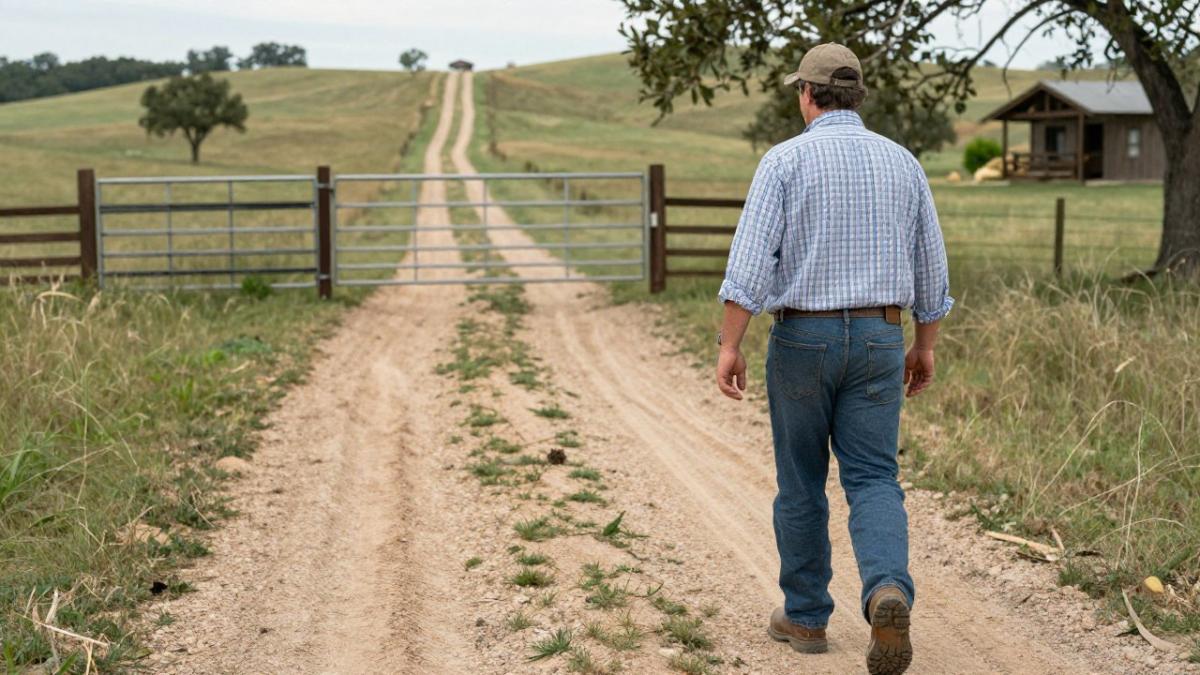
This is the step most buyers skip, and it is where the expensive mistakes happen. A route you can drive is not the same as a route you have a right to drive. Your job here is to build a side-by-side comparison of what exists on the ground and what exists in the record, then reconcile every difference before you commit.
Build the physical picture first
Walk or drive the entire route from the public road to the building site, not just the first hundred yards. Record these details as you go:
- Where the route crosses each parcel boundary. Use the survey or a GPS app to note the crossing point and the name of the owner of record for each parcel.
- Width and surface. Note whether the route is a graded gravel road, a two-track, a dirt path, or a paved lane. Measure the narrowest pinch point, because that width often controls what vehicles and emergency equipment can pass.
- Gates, locks, cattle guards, and cables. Photograph every barrier and note who controls it. A gate is not automatically a problem, but an uncontrolled gate is a question you must answer.
Then overlay the legal picture
Pull the deed, the title commitment, the recorded plat, and any recorded easement documents. For each segment of the physical route, answer three questions:
- Is there a recorded right to cross this parcel? If yes, identify the document by recording number and read the granting language.
- Who benefits from the right? Some easements run to a specific parcel and its successors; others are personal to a named party and do not transfer when the land sells.
- What does the right actually permit? Look for language on width, surface, maintenance obligations, permitted uses (residential only versus agricultural or commercial), and whether utilities may be installed within the easement.
Reconcile the two pictures
Lay the physical route next to the legal route. Three outcomes are possible, and each has a different consequence:
- The routes match. The recorded easement covers the same path you walked, the width is adequate, and the permitted uses fit your plans. This is the clean outcome.
- The physical route is wider or longer than the legal route. The extra portion may be used by permission only. Permission can be withdrawn, and it usually is when ownership changes.
- The legal route exists but the physical route does not. A recorded easement that has never been improved may still be usable, but you may bear the cost of building the road and any culverts or grading required.
Watch out: A seller's assurance that "we've always used that road" is not a legal right. Long use can sometimes support a prescriptive easement, but the requirements are strict, the outcome is fact-specific, and litigation is expensive. Treat verbal history as a lead to investigate, never as proof.
Document the comparison
Before you remove any contingency, assemble a simple access file: the survey with the route marked, the title commitment with each access-related exception highlighted, copies of every recorded easement, notes from the county road department on the public road status, and photographs of gates and pinch points. A real estate attorney and a licensed surveyor can review that file together and tell you whether the physical route and the legal route actually line up.
Step 4: Understand Types of Access Easements and How They Are Created
An access easement is a legal right to cross someone else's land. The type of easement matters because each one is created differently, proven differently, and limited differently. A recorded express easement is the strongest position. The others depend on facts that a court must weigh, and the rules vary by state.
Express easement
Created in writing, signed by the owner of the land being crossed, and recorded with the county. This is the type you want. Read the granting language closely for:
- Width and location. A 30-foot easement is not the same as a 60-foot easement when it comes to building a driveway, running utilities, or meeting fire-access standards.
- Purpose. Language limited to "ingress and egress" may not cover utility lines, agricultural equipment, or commercial vehicles.
- Maintenance. Who pays to maintain the road, and what happens if one party refuses? Many easements are silent on this, which becomes a dispute later.
Implied easement
Arises from the circumstances of how a parcel was divided, even if no document was signed. A common pattern is a parent parcel split into two tracts where the rear tract has always been reached across the front tract. Courts look at whether the use was apparent, continuous, and reasonably necessary at the time of the split.
Easement by necessity
Sometimes called a way of necessity. Granted when a parcel has no access to a public road and the access can only reasonably come across a specific neighboring parcel. The classic case is a landlocked tract that was once part of a larger parcel and was cut off when the owner sold the surrounding land. The requirements and the scope of the easement vary by state, and courts generally limit it to what is reasonably necessary.
Prescriptive easement
Based on open, continuous, and adverse use for a period set by state law, without the owner's permission. This is the hardest type to prove and the easiest to lose. Using a road with the owner's permission defeats the claim, because permission is not adverse. Neighbors who want to preserve a prescriptive claim often avoid asking for permission in writing, which is exactly why a buyer should not rely on a prescriptive claim without a lawyer's review.
How to verify which type applies
Work through these questions in order:
- Is there a recorded document? Search the county clerk's records under the parcel's legal description and the names of prior owners. If you find one, read it in full.
- If not, how was the parcel created? Pull the chain of title and the subdivision plat. A split from a larger parcel is the most common source of implied easements and easements by necessity.
- What does the physical use look like? Continuous use over many years may support a prescriptive claim, but only if the use was adverse and the state's time period has run.
- What does state law say? Access rules are set by state statute and case law, and they change. A local real estate attorney can tell you which doctrines apply and how courts in your area have ruled.
Watch out: Do not assume that because a parcel is landlocked, an easement by necessity automatically exists. The doctrine is narrower than many buyers expect, and a court may refuse to grant one if another reasonable route exists or if the landlocked condition was created by the current owner's own actions.
What to ask your attorney
Bring the deed, title commitment, plat, and your access file to the attorney and ask specifically: which easement types could apply, what evidence would prove each one, what limits would attach to the right, and what the realistic cost and timeline would be to confirm or obtain the right.
The article distinguishes four ways legal access can be created, each with different strength and proof requirements.
| Easement type | How it is created | Strength |
|---|---|---|
| Express easement | Written, signed, and recorded | Strongest position |
| Implied easement | Arises from how the parcel was divided | Rarely insured without court order or recorded agreement |
| Easement by necessity | Parcel has no access except across a neighbor's land | Scope varies by state; limited to what is reasonably necessary |
| Prescriptive easement | Open, continuous, adverse use for the state's period | Hardest to prove; lost if use was with permission |
Step 5: Assess Whether You Can Build and What Permits Apply
Access affects whether you can build. Many counties require legal road access before issuing a building permit or septic permit. Some also need emergency vehicle access.
Contact the county permitting office early. Ask what access documentation they require for a new home, barn, or well.
Common Red Flags and Costly Mistakes to Avoid
Watch for these warning signs:
- A seller who cannot produce a recorded easement
- Access that depends on a verbal agreement with a neighbor
- A title commitment with vague or missing access exceptions
A common mistake is assuming an old farm road will remain open. Owners can change, and unrecorded rights may disappear.
For more on what to check before purchase, see our guide on what should you look for when buying ranch land. Hidden costs can add up quickly, so review the hidden costs that can follow an access problem before you commit.
Your Next Step: Get a Property Access Review Before You Close
If you are buying from out of town, learn how to buy Texas land remotely without getting burned. Connect with Monica Allison now to start your property access review.
Frequently Asked Questions
Can a property be legally landlocked?
Yes. A parcel can have no legal right to cross neighboring land, even if it is physically reachable by a rough track. Legal landlocked status depends on recorded deeds, easements, and public road frontage. A title search and a review of county road records will show whether the property touches a public road or holds a recorded right-of-way. If it does not, you will need an easement, a negotiated agreement, or a court process to gain enforceable access. Verify the status before you rely on any route.
Should you buy land that is landlocked?
It depends on whether you can secure enforceable access before closing. Buying landlocked land without a recorded easement or a signed access agreement can leave you with a parcel you cannot legally reach or develop. Ask your attorney to review the title commitment, check for recorded easements, and confirm access with the neighboring owners in writing. Price the land with the access risk in mind, and make your offer contingent on satisfactory access documentation.
What are the common red flags of a landlocked property?
Watch for a legal description that refers only to a neighboring parcel, no frontage on a county or state road, access that runs through a gate you do not control, and a title commitment listing an access exception. Other warning signs include a seller who cannot produce a recorded easement, a route that crosses several owners, and county records that do not show the road as public. Any of these should trigger a deeper title and survey review.
Can I force an easement if my property is landlocked?
In many states, a landowner whose parcel has no legal access may petition a court for an easement by necessity, though the rules vary and the process can be slow and costly. Courts generally look for a shared former owner and a genuine necessity. A negotiated easement with the neighbor is usually faster. Consult a real estate attorney licensed in your state before pursuing litigation, and gather your deeds, plats, and survey first.