 How-to
How Do You Evaluate Ranch Water Rights?
Last Updated: October 28, 2026
Quick Summary
Evaluate ranch water rights by confirming the permit's source, place of use and permitted quantity against the land and your planned use, then checking the deed chain and well records. Water rights are a legal permission to use water, not ownership of it, so a name match on a state database does not prove the rights convey with the property.
- Check the TCEQ database for surface-water permits and the local groundwater district for groundwater rules.
- Confirm the permit's source, place of use and permitted quantity match the land and your intended use.
- Request the well log and at least five years of pump test results before relying on groundwater.
- Verify in the deed chain that the water rights actually run with the land you are buying.
- Treat water as a risk-adjusted asset, scoring reliability, transfer risk and usable quantity.
Table of Contents
- What Ranch Water Rights Actually Convey
- Step 1: Pull the Texas Water Rights Records Search
- Step 2: Confirm the Source, Place of Use and Permitted Quantity
- Step 3: Assess Groundwater Rights and Well Condition
- Step 4: Evaluate Reliability, Transfer Risk and Value Impact
- Your Ranch Water Rights Due Diligence Checklist
- Scheduling Your Water Rights Review Before You Make an Offer
- Frequently Asked Questions
What Ranch Water Rights Actually Convey
Water rights are a legal permission to use water, not ownership of the water itself. In Texas, the state holds the water and grants rights to use it.
Many buyers assume a well on the land means water rights come with it. That is not always true. A well can exist without a valid permit for the amount being pumped.
Surface water versus groundwater rights
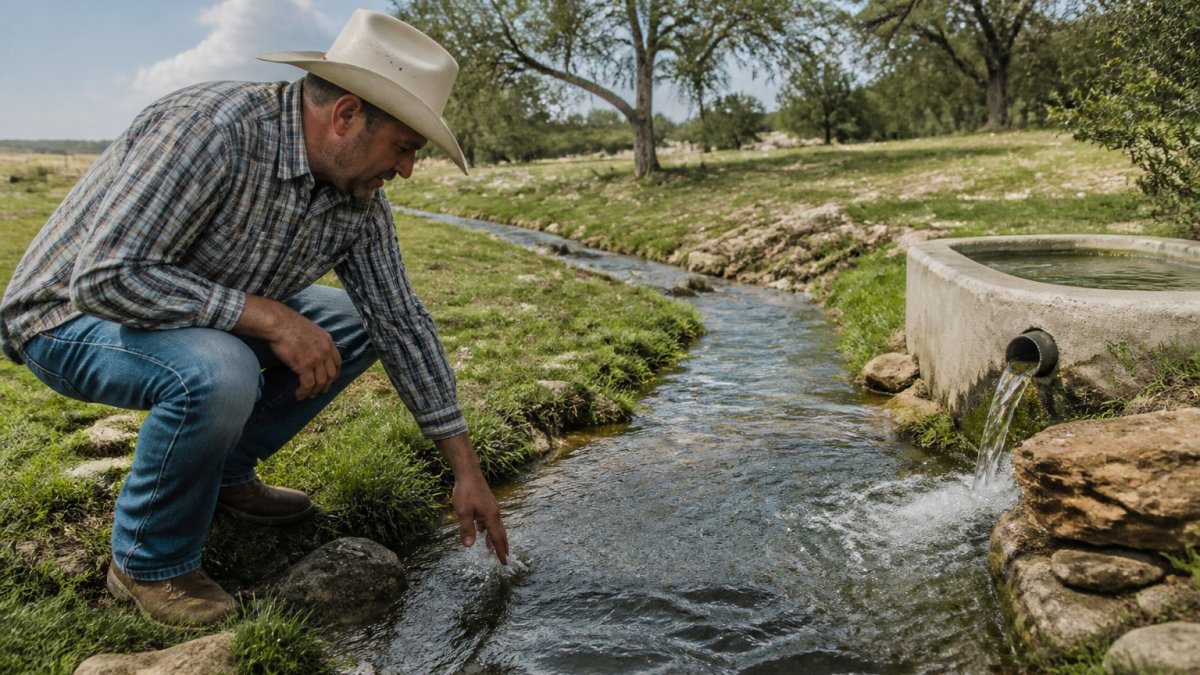
Surface water is water in creeks, rivers, stock tanks and reservoirs. Groundwater is water beneath the surface, pulled up through wells. Texas treats these two sources differently, so the rules for each are not the same.
- Surface water rights are generally handled through the state's water rights permitting system.
- Groundwater rights depend on the property and the local groundwater district rules.
- Both types can limit how much water you use and what you use it for.
Check which type the property relies on. A ranch that depends on a spring-fed creek has a very different water picture than one that depends on a well.
Why water rights vary by county and watershed
Water rules are not the same across the state. Local groundwater conservation districts set limits in many counties, and river basins have their own priorities. A right that works well in one county may be restricted in the next.
Ask who regulates water in the specific county where the land sits. That answer shapes everything else in your evaluation.
Step 1: Pull the Texas Water Rights Records Search
Start with the official records, but treat the search as a layered process rather than a single lookup. Water rights in Texas are split between surface water and groundwater, and the records live in different places. A complete search touches at least three sources: the state surface-water permitting system, the local groundwater conservation district, and the county clerk's office.
Surface-water records
The Texas Commission on Environmental Quality (TCEQ) maintains the state's surface-water right permits, certificates, and applications. Search the TCEQ water rights database by permit number, owner name, county, or water source. Texas Commission on Environmental Quality water rights database Pull the current version of every record you find, not a printout the seller supplies. Note the permit number, priority date, authorized diversion rate, annual volume, place of use, and any special conditions.
Groundwater records
Groundwater is regulated locally in most of the state. Contact the groundwater conservation district that covers the county where the ranch sits and ask whether the property has a permitted well, what pumping limits apply, and whether the district has a management plan or desired future conditions that affect the aquifer. The Texas Water Development Board publishes district contact information and background. Texas groundwater conservation district information If the property is outside a district, groundwater is generally governed by the rule of capture, but that does not remove the need to verify the well itself.
County and deed records
Water rights can be severed from the surface estate and conveyed separately. Pull the deed history from the county clerk and look for reservations, exceptions, easements, and assignments that mention water. A right that appears in a TCEQ record may have been transferred, leased, or reserved by a prior owner. The deed chain is where you confirm whether the right actually runs with the land you are buying.
What to collect
Build a file with these documents before you move to Step 2:
- Current TCEQ permit or certificate, including all amendments and conditions
- Groundwater district permit or registration, if any
- Well log and pump test records from the seller or the driller
If the search turns up nothing, that does not mean there are no rights. Some water use predates the current permit system, and some groundwater use is unpermitted by design. Ask the seller for documents, and have a water attorney confirm the answer before you rely on it. Research mineral rights before buying land to see how mineral ownership can affect value and control.
Step 2: Confirm the Source, Place of Use and Permitted Quantity
Next, compare the permit against the property. Three things need to match:
- The source: The stream, reservoir or aquifer named in the permit should be the one the land actually uses.
- The place of use: The permit names where the water can go. If the permit covers a different parcel, the rights may not reach your land.
- The quantity: The permit sets a maximum amount. Compare it with how much water your intended use requires.
For example, a permit for livestock watering may not cover irrigating a new hay field. Mismatches like this are common, and they are expensive to fix later.
Step 3: Assess Groundwater Rights and Well Condition
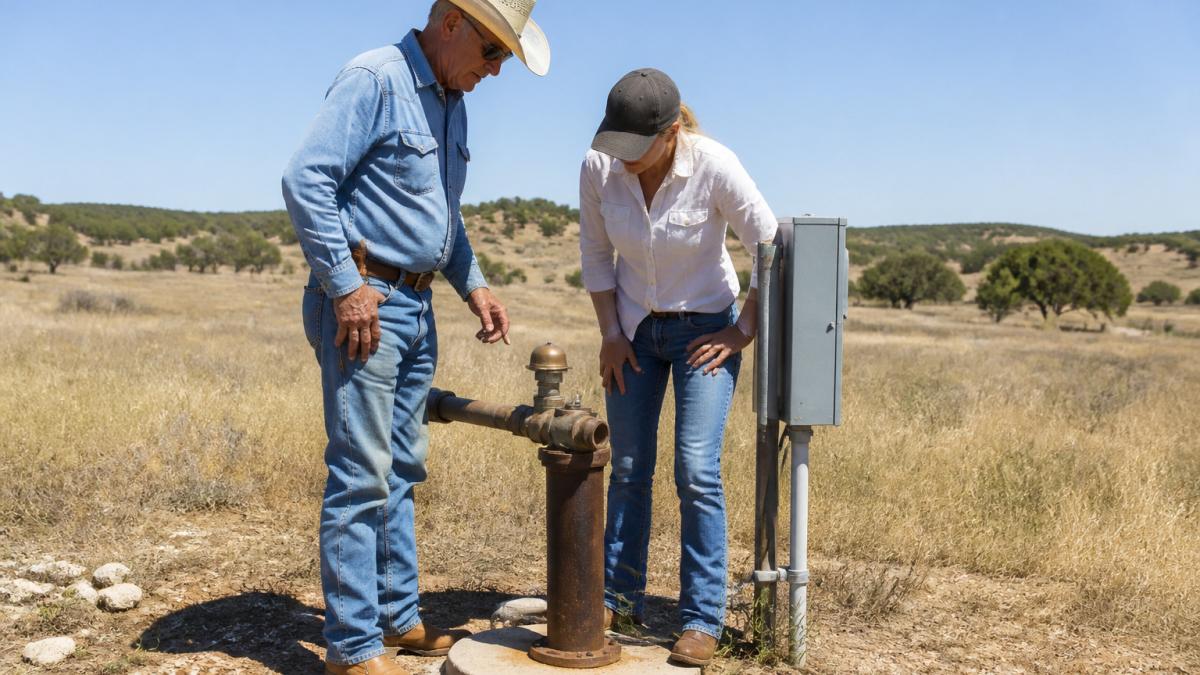
If the property depends on a well, check the well itself. Ask for the well log, which records the depth, casing and water-bearing zones.
Connect with Monica Allison now. →
Look for these signs of trouble:
- Low flow rate during a test pump
- Cloudy or discolored water
- Old or damaged well casing
Groundwater rights also depend on the local district. You can review Texas groundwater conservation district information for background on how these districts operate.
Step 4: Evaluate Reliability, Transfer Risk and Value Impact
A water right on paper is only useful if the water is there when you need it, if it can be moved or repurposed, and if the price you pay reflects those risks. Most buyers treat these as three separate questions. A better approach is to score them together so you can compare two ranches on the same scale.
Score reliability first
Reliability has four inputs: priority date, source type, seasonal pattern, and drought history. A senior surface-water right with an early priority date is generally more reliable than a junior right on the same stream, because in a shortage the senior right is satisfied first. Groundwater reliability depends on the aquifer, the district's pumping limits, and the well's tested flow rate. Ask the seller for at least five years of pump test results and any records of shortages, hauling, or temporary reductions. Talk to neighbors who have run livestock or irrigation on the same source.
Score transfer risk second
Transfer risk turns on whether the right can change use, place of use, or point of diversion, and what approval that requires. In Texas, a change to a surface-water right generally requires an amendment application to TCEQ, and the process can take months and involve notice to other water-right holders. Groundwater transfers may require district approval or may be restricted by district rules.
Score value impact third
Water affects ranch value through usable quantity, not paper quantity. A permit for 500 acre-feet per year that cannot be delivered in July is worth less than a smaller right that runs all season. Reliable rights often support higher prices per acre, while doubtful rights should push your offer down or trigger a price adjustment. Get an appraisal that separates the land value from the water value, and ask the appraiser to state the assumptions behind the water component.
A simple comparison framework
For each property, rate reliability, transfer risk, and usable quantity on a simple high, medium, or low scale, and write one sentence explaining each rating. Then compare properties side by side. This does not replace a water attorney or an appraiser, but it forces the analysis onto paper and exposes the assumptions behind the price.
Watch out: Do not treat a water right as secure just because it has existed for decades. Permit conditions, district rules, and drought patterns can change, and a right that was adequate under one owner may not support a more intensive use under the next.
The article's three-part evaluation can be compared side by side, so here is a summary of what each factor asks you to check.
| Factor | What to check | Key point |
|---|---|---|
| Reliability | Priority date, source type, seasonal pattern, drought history | Senior rights are satisfied first in shortages |
| Transfer risk | Change approvals, lease terms, use-or-lose rules, liens | Surface-water changes may take months at TCEQ |
| Value impact | Usable quantity, appraisal separating water value | Usable water matters more than paper quantity |
Your Ranch Water Rights Due Diligence Checklist
Use this checklist before you make an offer:
- Pull the official water rights records for the property, then review the broader ranch land buyer's checklist for the other items you still need to inspect.
- Confirm the source named in the permit matches the land
- Confirm the place of use includes your parcel
Keep a written record of each answer. It will help you compare properties later.
Scheduling Your Water Rights Review Before You Make an Offer
Set up the water rights review before you submit an offer, not after. Schedule time with a water attorney, a well contractor and the local groundwater district. Give yourself enough time to get answers before your option period ends.
Connect with Monica Allison now.
Frequently Asked Questions
How do water rights work when buying a Texas ranch?
In Texas, owning land does not automatically give you the right to use water on it. Surface water rights are generally granted by the state through permits and are administered under the prior appropriation system, meaning the earliest priority date is served first during shortages. Groundwater rights are generally tied to the land and are governed differently, with landowners able to pump for certain uses under the rule of capture, subject to local groundwater conservation district rules. Review the seller's permits, certificates and any well registrations before you assume water comes with the property.
How can I verify water rights on a ranch?
Start with the Texas Commission on Environmental Quality water rights database, which lists permits, certificates and applications for surface water, along with their authorized uses, quantities and priority dates. Then check with the local groundwater conservation district for well registrations, permits and production limits in the county. Compare the records against the seller's documents, and confirm that the point of diversion and place of use match the property boundaries. Discrepancies are worth raising with a water attorney before you proceed.
What records should I review before buying ranch land with a pond or creek?
Request the water rights permit or certificate for any impoundment or diversion, including the authorized use, maximum diversion rate and storage amount. Review dam safety records if the pond is large enough to be regulated, and any prior correspondence with the state. Confirm whether the pond is on-channel or off-channel, since that affects permitting requirements. Ask for recent photos or a site visit to verify that the structure matches the records and that the water source is what the seller describes.
What water-rights issues can affect a ranch's value?
Limited or junior priority dates can leave a ranch without water during drought, which lowers reliability and value. Water rights that are restricted to certain uses, such as livestock only, may not support irrigation or a planned residential build. Unrecorded uses, expired permits or wells without registration can create title exceptions and require costly corrections. Transfers may require a change application, which takes time and is not guaranteed. Build these risks into your offer price or make them contingencies in your purchase agreement.