 blog
blog
Find Hunting Land for Sale Texas: 2026 Buyer's Guide
Table of Contents
- Regional Hunting Land Markets Across Texas
- How to Evaluate Hunting Land Quality Before You Buy
- High-Fenced vs. Low-Fenced Properties and What They Cost
- Financing Hunting Land Purchases: Loans, Terms, and Lender Types
- Agricultural Tax Exemption for Hunting Land in Texas
- Legal Due Diligence: Easements, Mineral Rights, and Title Work
- Post-Purchase Land Improvement and Hunting Lease Potential
- Conclusion
- Frequently Asked Questions
Last Updated: September 27, 2026
Regional Hunting Land Markets Across Texas
To find hunting land for sale Texas buyers should start by understanding the state is not one market but several, each with its own terrain, game, and price drivers. This guide breaks down what buyers need to know before making an offer.
How to Evaluate Hunting Land Quality Before You Buy
Hunting land quality is determined by three factors: topography, water, and habitat. A parcel that scores well on all three supports more game and holds it longer through the season.
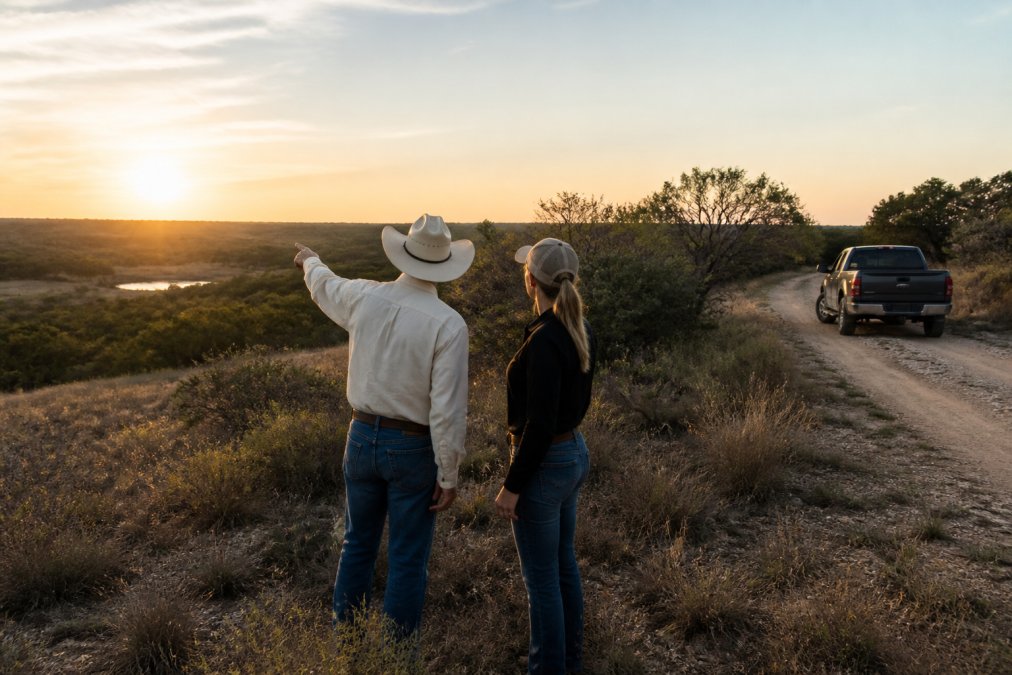
Reading Topography, Water, and Habitat on a Tract
Topography shapes how animals move. Ridges, draws, and creek bottoms create natural travel corridors. Flat, featureless ground offers fewer ambush points and less bedding cover.
High-Fenced vs. Low-Fenced Properties and What They Cost
High-fenced properties almost always cost more per acre than low-fenced tracts of similar size and location, and the gap is driven by more than fence wire. Understanding what creates that premium, and what it costs to maintain, is the difference between buying a managed asset and a liability.
What the Fence Itself Costs
A high fence is a capital improvement, not a one-time purchase. A new high fence can run into the tens of thousands of dollars per mile installed, depending on terrain, corner posts, gate count, and ground type. Rocky Hill Country ground and Brush Country caliche drive costs up because posts must be set with equipment rather than by hand.
What the Premium Actually Buys
A high fence does three things a low fence cannot:
- Genetic control. Native and released genetics stay inside the boundary, so a management program compounds year over year instead of being diluted by neighboring harvest pressure.
- Age structure. Bucks can be held to maturity because they cannot be legally harvested off-property before they reach target age.
- Harvest predictability. The owner knows roughly what is on the property and can plan harvest quotas against a known population.
What the Premium Costs You Every Year
Ongoing costs on a high-fenced property include:
- Fence inspection and repair after storms, fallen trees, and hog damage
- Supplemental feeding programs, often year-round rather than seasonal
- A written wildlife management plan in most cases, especially if the owner wants to keep an agricultural valuation
- Predator and hog control, since a fenced property concentrates animals and can concentrate pressure
A low-fenced property shifts much of that burden to neighbors: lower acquisition cost and upkeep, in exchange for less control over what walks onto the property.
How the Two Compare in Practice
| Property Type | Typical Price Position | Best For | Key Trade-Off |
|---|---|---|---|
| High-fenced | Higher per acre | Trophy management, controlled harvest, predictable age structure | Higher acquisition cost, mandatory annual upkeep, narrower resale pool |
| Low-fenced | Lower per acre | Mixed use, weekend recreation, resale flexibility | Depends on neighbor management and regional genetics |
| Partially improved | Mid-range | Buyers who want to build habitat and water themselves | Variable quality; improvements may not match your goals |
The Middle Path Buyers Overlook
Pricing depends on region, acreage, water, improvements, and management history, so confirm current figures with a local agent rather than relying on averages.
Financing Hunting Land Purchases: Loans, Terms, and Lender Types
Financing hunting land works differently from financing a home. Land loans typically require larger down payments, carry higher rates, and come from a narrower set of lenders.
Most buyers use one of three paths:
- Local bank or credit union with a land lending program
- Farm Credit System institutions, which specialize in agricultural and recreational property
- Seller financing, common on ranch and recreational tracts
Agricultural Tax Exemption for Hunting Land in Texas
Agricultural tax exemption for hunting land in Texas is one of the most misunderstood and most consequential parts of ownership. It is a property tax valuation, not a discount you request, and the difference between qualified and unqualified land can be thousands of dollars a year on a modest tract.
The Two Paths to Qualification
Traditional agricultural use. The land is used for livestock grazing, hay production, row crops, orchards, or similar activities. The owner must show actual agricultural activity and meet minimum acreage and use requirements set by the county appraisal district.
Connect with Monica Allison now. →
What the Wildlife Management Plan Requires
The wildlife management plan is not a one-time form but a multi-year commitment with documentation.
- Habitat control (brush management, prescribed burning, native seeding)
- Erosion control
- Predator control
- Providing supplemental water
- Providing supplemental food (food plots, feeders)
- Providing shelter, including nesting and bedding cover
- Census and population counts
The Acreage Question
There is no single statewide minimum acreage for agricultural valuation. Each county appraisal district sets its own standards, which can differ substantially, a tract that qualifies in one county may not qualify in the next.
Rollback Taxes: The Cost of Losing Qualification
When land receiving an agricultural valuation changes to a non-agricultural use, the county can impose a rollback tax. The rollback recaptures the difference between agricultural taxes paid and the higher non-agricultural rate, typically going back several years, plus interest.
What to Verify Before You Buy
- Current valuation status. Is the land currently under agricultural or wildlife valuation, and under which path?
- The written plan. If it is a wildlife valuation, ask to see the plan and the landowner's activity records.
- County requirements. Call the appraisal district and confirm the minimum acreage and activity requirements for that specific county.
- Rollback exposure. Ask the title company and the appraisal district whether any rollback liability is pending or could be triggered by your intended use.
- Reapplication timeline. Most counties require the new owner to file a new application by a specific deadline, often tied to the January 1 assessment date. Missing it can cost a full year of higher taxes.
Buyers should confirm the current requirements with the Texas Comptroller's office and their county appraisal district before closing. The rules are stable but county-specific, and the only reliable answer is the one from the county that will be assessing your land.
Legal Due Diligence: Easements, Mineral Rights, and Title Work
Legal due diligence is where most rural land deals are won or lost. Unlike a subdivision lot, a ranch tract can carry easements, severed mineral rights, and access issues that never appear in a listing photo.
The essentials to verify:
- Access. Is there a deeded easement, or does the property rely on a neighbor's goodwill?
- Mineral rights. Are they included, partially conveyed, or fully severed?
- Water rights. Who owns the groundwater, and are there existing wells or permits?
- Survey. Does a current survey match the legal description and fences?
- Title. Are there liens, judgments, or heirship issues on the tract?
Post-Purchase Land Improvement and Hunting Lease Potential
Post-purchase improvements determine what the land becomes. New owners who invest in water, food plots, and cover see better hunting within a few seasons.
Conclusion
Buying hunting land involves far more than picking a parcel off a map. Water, access, mineral rights, tax valuation, and habitat all shape what the land is worth to you and to the next buyer.
Connect with Monica Allison now to start your search.
Frequently Asked Questions
What is the 13-inch rule for deer hunting in Texas?
The 13-inch rule is a Texas Parks and Wildlife Department antler restriction that applies in certain counties. A legal buck must have an inside spread of at least 13 inches or at least one unbranched antler. It is designed to let younger bucks mature. If you buy hunting land in a restricted county, this rule shapes how you manage the herd and what you can harvest each season.
How do I evaluate the wildlife habitat on a potential land purchase?
Walk the tract and look at three things: cover, food, and water. Dense brush, native grasses, and mature hardwoods hold whitetail deer and game species. A stock tank or creek with reliable water is a major plus. Check for signs like rubs, scrapes, and trails. Ask the seller for harvest records or trail camera photos. A knowledgeable hunting land Texas agent can help you read topography and habitat before you make an offer.
What are the tax implications of buying agricultural-exempt land?
If a property holds an agricultural tax exemption, you inherit that valuation when you buy, but you must keep the land in qualifying use. In Texas, wildlife management is one qualifying use, and it can be a strong fit for hunting land. If you convert the land to another use, the county can recapture several years of deferred taxes. Confirm the current exemption status and any rollback risk during due diligence.
Are there specific zoning regulations for hunting land in the Hill Country?
Most rural Texas counties do not have zoning, but they do have subdivision rules, floodplain regulations, and sometimes county-level land use ordinances. Check for restrictions on high-fenced properties, commercial hunting operations, and short-term rentals. Easements and deed restrictions can also limit how you use the land. A title company and a local realtor can flag these issues before closing.
The land will outlast the transaction, so get the details right before you sign. Monica Allison, realtor brings local market knowledge, farm and ranch experience, and a straightforward approach to due diligence. Reach out to discuss your goals and see properties that actually fit them.